
to live the questions
a few days spent in Venice

I landed yesterday evening, from a five-day long trip to Venice with my friends. Five days spent walking around, going to (so many) exhibitions, eating the most delicious pasta and filling my heart with laughter and art.
This trip was memorable in so many ways, notably because this time around in Venice, the Biennale of Art is happening. Held in two locations (the Gardens and the Arsenale), I got to discover a lot of artists I didn’t know before, to wander in an environment filled with creativity and passion (and also some Pretty Weird Art That Practically Traumatized Me). As someone who’s always loved art, this was such an incredible experience and a chance to determine what speaks to me and what doesn’t.
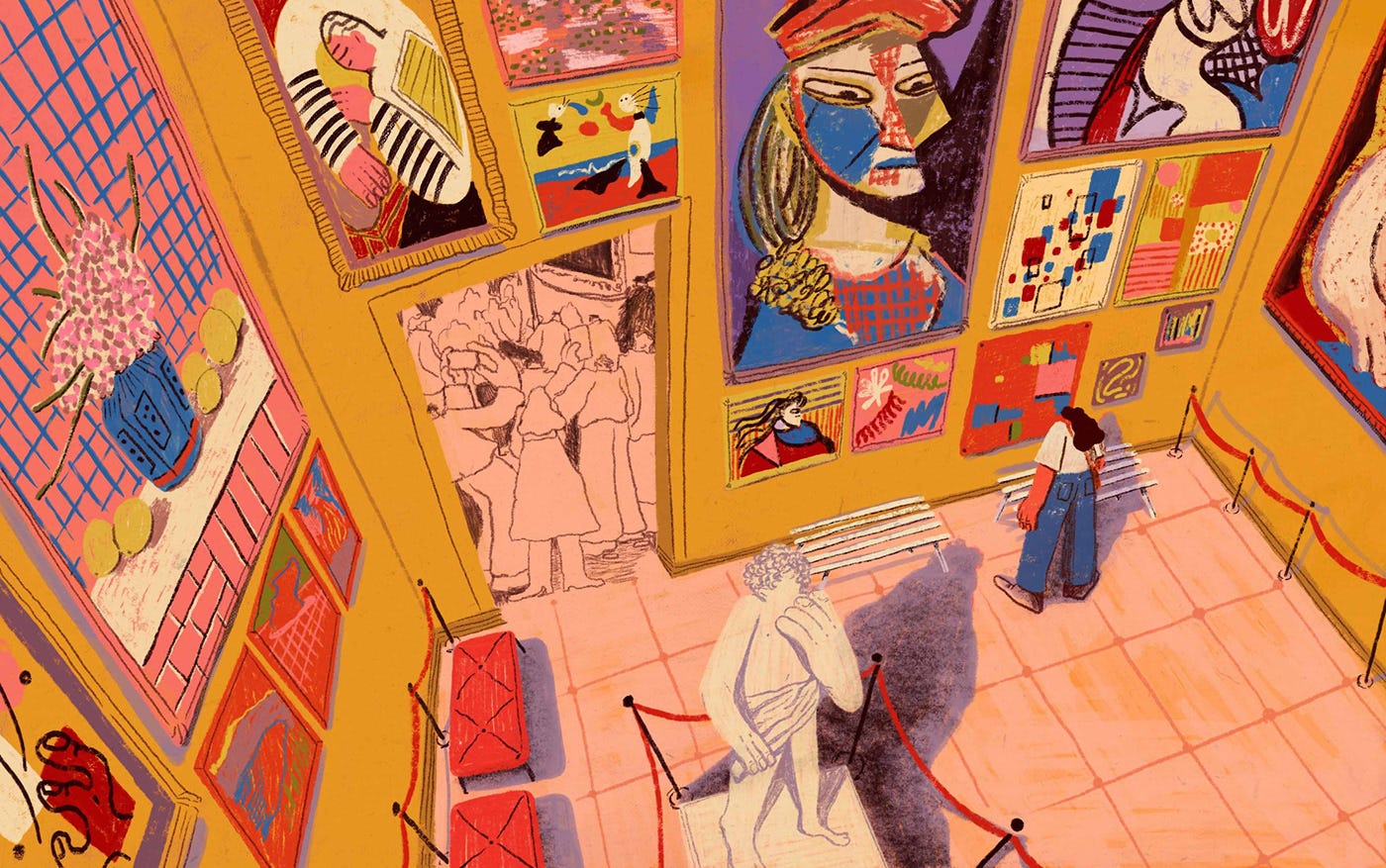
Lately, I’ve been thinking a lot about what art means to me and Why. Part of it relies on its ability to make me, to make us, connect. Isn’t that what we look for the most as humans? I think it’s what I personally look for, more and more as the years go by and as I grow up. In Episode 1 of Season 2 of Intersections : The Art Basel Podcast, guest speaker Kim Namjoon talked about his experience with art :
“They’re [in reference to painters like Picasso or Monet] all dead. But for now, in 2018, some outsider from South Korea in here, in this small room, me and his footprint — or some pieces of his time — just encountered, and it still gives me a thrill.”
There’s a solace, a comfort that art provides that I have yet to find in any other area in my life. The knowledge that someone lived and that something, whatever and wherever it might be, can still reach me. That a human has lived, lived, lived. An act of remembrance.
Visiting exhibitions, art foundations, monuments, all those glimpses of the past, it makes me feel alive. There’s something to be said about how art helps us not only grow as humans, whether we create or consume it, but also how it helps us ground ourselves and explore our identities. How it helps us pinpoint what we love and what we hate, who we are and who we are not. How it can bring on a diversity of emotions, from joy to reassurance to disgust to confusion to sadness.
Ai Weiwei, a Chinese artist living and working in Beijing, wrote in On Poetry : The Cultural Revolution—and the necessity of culture :
To experience poetry is to see over and above reality. It is to discover that which is beyond the physical, to experience another life and another level of feeling. It is to wonder about the world, to understand the nature of people and, most importantly, to be shared with another, old or young, known or unknown.
While this quote is about poetry, I like to think it applies to art in general. To wonder about the world in an attempt to understand it better. Art has held me in the palm of its hands and given me the chance to look outside my window and see more than what meets the eye. It’s reminded me of my humanity, of the ephemerality of life, in the most soul-bearing, alleviating way.
Rainer Maria Rilke, in Letters to a Young Poet, wrote :
“You are so young, so before all beginning, and I want to beg you, as much as I can, to be patient toward all that is unsolved in your heart and to try to love the questions themselves—like locked rooms and like books that are written in a very foreign tongue. Do not now seek the answers, which cannot be given to you because you would not be able to live them. The point is, to live everything. Live the questions now. Perhaps you will gradually, without even noticing it, find yourself experiencing the answer, some distant day.”
And isn’t that what art allows us to do? To live and love the questions, in the hopes of one day stumbling upon the answers.
✰ a poem for small things
Watching the Twilight movies at night with my friends while drinking Bellinis and eating Oreos
Meeting Sammy, a dear friend I met online in 2020, that I finally (!) got to meet IRL in Venice. We bought matching heart-shaped necklaces, visited the Peggy Guggenheim Foundation and spent the loveliest day together. I’ll cherish these memories forever.
J-Hope’s MORE. I, too, shout out. I say More. This song just displays Hoseok’s range and versatility and reinforces the knowledge that you need to speak to him very nicely because he has never missed a day in his life.
✰ when art makes me feel (alive)
Today, I’d like to talk to you about this year’s winner of the Venice Biennale’s Golden Lion (the highest prize), Simone Leigh.
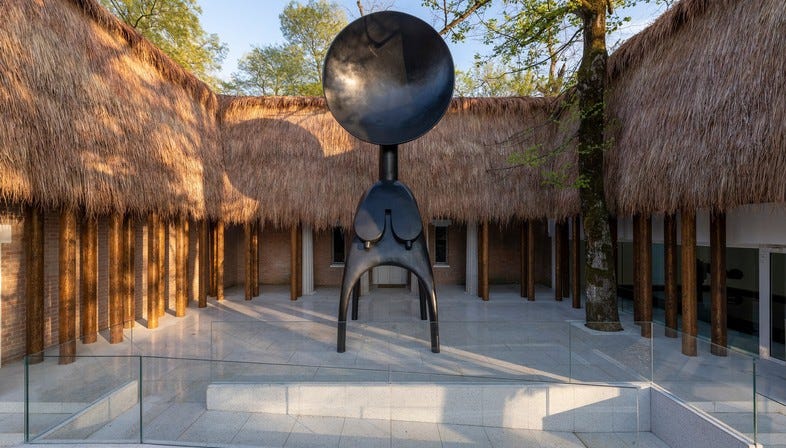
Sovereignty is a body of work created for the U.S. Pavilion, which she represented during the Biennale. Through her use of materials such as bronze and ceramics, she creates large-scale sculptural works focuses on themes of self-determination, as well as celebrating the history and role of Black women, by confronting the audience with their representation and authority.
Many of the featured sculptures interrogate the extraction of images and objects from across the African diaspora and their circulation as souvenirs in service of colonial narratives. Leigh uses a strategy which she calls “the creolization of forms”, combining disparate cultural languages that are linked through colonization. Though Leigh’s figural works present their subjects as autonomous and self-sufficient, they do not simply celebrate the capacity of Black women to overcome oppressive circumstances, but rather indict the conditions that so often require them to affirm their own humanity.
The entire façade of the U.S Pavilion was reshaped to evoke a 1930’s West African Palace. The monumental sculpture Satellite, is reminiscent of the traditional masks in the shape of a woman's bust used by the Baga populations of Guinea to communicate with their ancestors. The mask is transformed here into architecture, the face having the shape of a parabolic antenna to indicate not only the possibility of sending messages but also of intercepting and deciphering signals coming from outside.
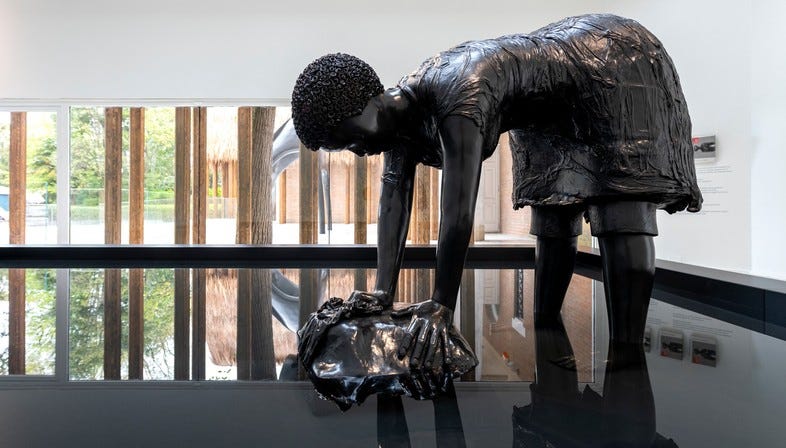
As Eva Respini, curator of the pavilion, explained Leigh’s work is heavily linked to her manual practice of sculpture. Her presence at all stages of the production is clearly felt in her artworks and allows her to highlight the subject close to her heart of the work of black women, both physical and intellectual, often misunderstood and neglected in history.
📬 for further reading :
✰ Simone Leigh: Sovereignty at the U.S. Pavilion
✰ Simone Leigh Opens Much-Anticipated, Historic Exhibition at Venice Biennale, Becomes First Black Female Artist to Present Solo Show in U.S. Pavilion
✰ Artist Simone Leigh Embodies Self-Determination in the Historic ‘Sovereignty’ at the Venice Biennale
—
‘til next time,
lots of love,
noa <3
joon would love this one <3